


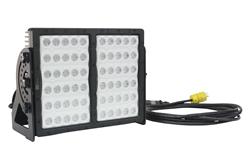
Larson Electronics 300 Watt High Intensity LED Light
Although LED lighting is by most accounts settling into a rosy picture of robust growth and future development, there remain some significant issues which could directly affect the rate of its adoption and production. Before LEDs reached their current level of effectiveness, problems with low output, color quality, and heat management were the biggest concerns. Now that LEDs rival or surpass most other forms of lighting performance wise, the focus is shifting away from developmental issues. Problems with supplying sufficient quantities of rare earth elements, standardization among module developers, and effective heat management now top the list of hurdles to be passed before LEDs make the full leap to dominance in the lighting marketplace.
LEDs are a solid state form of lighting that demonstrates a radical departure from the way we usually produce illumination. As a result, there have been new challenges developers and manufacturers have had to overcome before LEDs could be considered a viable lighting technology. LEDs are solid state in design, and rather than produce light through the process of incandescence, (heating a wire until it glows and radiates light), produce light through a process called electroluminescence. At a basic level, LEDs work by passing current through sandwiched layers of semi-conducting material which has been coated with other materials to alter its properties. As the current passes through one material to another, the electrons combine with holes in the layered materials, whereupon energy is released in the form of photons or, visible light. In this process current can only flow one way, and the properties of the semi-conducting materials and the materials they are doped with will determine the wavelength of the energy released.
Heat Management-
LED developers learned over time that significant visible light output could be produced, and later determined how to produce white light suitable for general illumination. Early issues included limited color wavelength capabilities, low output, and heat generation. As developers discovered new materials to dope the semi-conducting materials with, they became able to produce higher light output and better wavelength control. At their current stage of development, LEDs are now able to surpass all forms of lighting in overall performance, with HID lighting the only type still capable of higher overall output. Despite all of this improvement, issues with heat management still remain. Although LEDs produce relatively little heat in comparison to their incandescent counterparts, due to their small size and high output, the heat they do generate is concentrated over a very small area, primarily at the junctions where current is fed into the LED. The problem here is, LEDs are highly sensitive to voltage changes and heat, and too much voltage or heat can result in drastically reduced performance, and premature failure. Compounding the issue, their small size makes it difficult to effectively remove the heat they produce as there is limited area over which it can dissipate. The primary solution has been to incorporate heat sinks which allow heat to be transferred away from the LED into the surrounding atmosphere and precise control of the voltages applied to the LED to prevent overheating.
For the most part, the current methods of controlling heat in LEDs have been effective albeit limited. Although the amount of current that can be fed into LEDs has risen as developers have incorporated more efficient heat controls, heat management still remains an issue and somewhat constrains luminaire design as well as LED versatility. For example, it is only recently that LED bulbs suitable for use in enclosed fixtures have become available, and before developers can reach the full overall output potential of LED technology, they must devise even more effective heat management systems. Despite this, LEDs have still reached a point where they surpass incandescent, fluorescent, and HID lighting in terms of output, longevity, efficiency, cost effectiveness, and versatility. The fact that LEDs have achieved this despite their current constraints, points to the high potential which brought about their fast paced development and the still untapped potential they hold for future improvements.
Rare Earth Elements-
Since LEDs are solid state in design, they require very different materials to be used in their construction. One of the more critical materials used involves rare earth elements, primarily phosphors, and including erium, europium, gadolinium, lanthanum, terbium, and yttrium. These are as their name implies, uncommon materials and not readily available in large supply. Currently, the United States has only one mine capable of supplying REEs in operation, and the bulk of world wide REEs consumption has been supplied by China. With China being a direct competitor for international LED technology markets, and their efforts to curb their export of REEs directly threatening the ability of competing countries to manufacture REE dependant technologies on a large scale, securing readily available domestic supplies of REEs is predicted by some experts to become one of the critical issues facing LED production in the near future.
To address this issue, the U.S. is currently encouraging the development of domestic rare earth element deposits. The U.S. holds significant deposits, but lax environmental controls, low labor costs, and heavy government support within China has allowed them to in the past price competitors out of the market. China is estimated to control 97% of the REE market and is expected to further direct their production to domestic supplies to support their own growing demand as well as increase the value of their desposits. Even with the reopening of the Mountain Pass mine in California and plans in place to develop deposits in Alaska, Montana, Colorado, Nebraska, and other states, demand in the U.S. is expected to outstrip supply within 5 to 10 years. To compound the problem, REEs are also critical to the production of other advanced technologies including cell phones, automobiles, MRI equipment, wind turbines, military weaponry, and other devices which in turn compete for these limited supplies. It is doubtful the United States can achieve a fully independent supply of these elements, however, with enough production in place, any shortages created by reduced importation can be more easily weathered and price increases kept modest.
As can be seen, the adoption of LED lighting is a more complicated issue than our first glance would suggest. For most of us, worries with light quality and lamp costs dominate our thoughts when considering LEDs, but for developers and manufacturers the issues go far deeper. How effective LED lighting becomes in the future depends in large part upon our continued support for development, and forward planning to overcome the challenges ahead.