


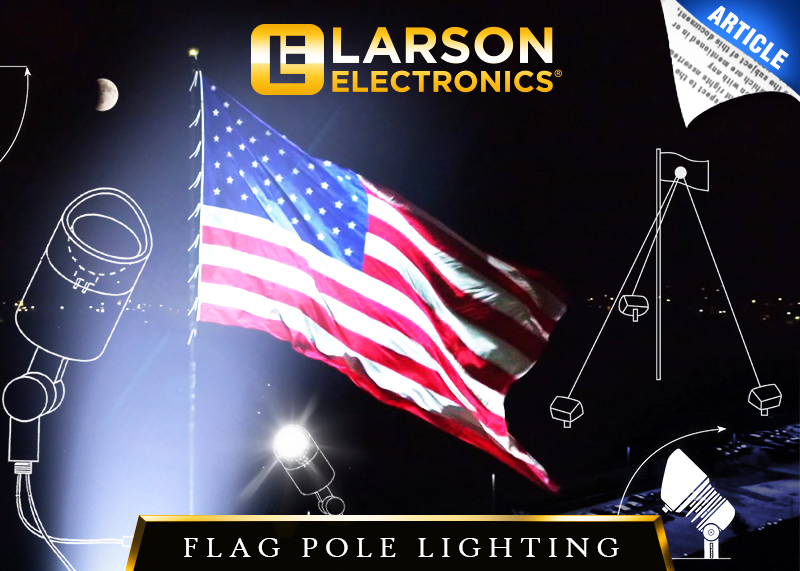
National flags are treated with care and respect, due to the patriotic attributes associated with the banners. In the US, the application of flags is governed by the Federal Flag Code. The guidelines offer best practices for the proper presentation of flags under various outdoor conditions and settings, which includes illumination during “hours of darkness.”
Why Light Up Flag Poles?
According to the Federal Flag Code (version 2008), national flags should be “preserved by lighting” in environments that could cause it to be “enveloped in darkness.” This concept was not fully expounded on in the circulation. The Congressional Research Service offers its own interpretation of the guidelines, suggesting that light does not necessarily need to be directed at the flag. General illumination of the area is recommended, as long as the flag can be seen. An explanation from the American Legion also backs up this recommendation, citing that sufficient illumination of flags (and flag poles) is achieved when the banner can be seen casually (with minimal effort).
In most cases, business and homes use spotlights to illuminate flags. The units are capable of reaching banners that are suspended hundreds of feet in the air. Because general illumination is only needed for the structures, powerful floodlights may also be applied. The luminaries are effective in capturing the movement of flags during windy conditions.
Basic Configurations, Angles and Measurements
Flag pole lighting configurations must take several factors into consideration for robust illumination. A general standard includes the use of two luminaries per flag – regardless of wind direction. Three LED lamps may be used for intense lighting requirements or for large flags. When three lights are applied, the units should form a triangular pattern on the ground (or mounting system). As for the distance of the fixtures, it is recommended for lights to be setup between 33 to 50 percent of the length of the pole. Flood lights could be positioned further, between 50 to 100 percent of the pole’s length. Some lighting specialists recommend setting the lights back 20 percent of the pole’s length. It is possible to experiment with preferred lighting configurations before installation.
When two LED lamps are used to light up a flag pole, each light should be capable of encompassing 180 degrees during illumination. The application of three LED fixtures requires an angle of 120 degrees each for even beam distribution.
In-ground installations are advisable for locations with high foot traffic, such as schools, stadiums, around statues, parks and event halls. Hard-to-reach areas, including hills, industrial structures, on top of buildings and more, may utilize mounted luminaries secured on brackets or small poles.
Low Voltage and Solar LED Lighting for Flags
LED lighting systems in general locations for flags that have access to conventional power sources may be equipped with heavy-duty power cords for connection to mainstream outlets and rugged housings for protection against outdoor contaminants. For increased safety during application and because flag pole luminaries are often left unattended, low voltage units can be applied. Such options require extra internal components that step down incoming AC voltage to 12V or 24V. Low voltage DC currents are considered to be safer to handle, compared to mainstream AC current, such as 120V AC or 240V AC. This type of power is closely associated with battery-powered luminaries.
Lastly, for remote flag pole installations, solar-powered LED lights are highly recommended. As a sustainable lighting solution, the units are low voltage and do not need direct access to the city grid. Day/night sensors could automate the operation of flagpole lights by activating the units when low-light conditions are detected.