


Cryptocurrency is a multi-faceted technology designed to boost financial transactions, smart contracts and anonymity in the digital world. With a market cap of $445 billion (as of March 6, 2018), the industry is still in its infancy.
This article explores power and heat-related challenges faced by commercial bitcoin mining operations.
Bitcoin Mining Overview
The technology that underpins bitcoin and other cryptocurrencies is a blockchain, which is an irrefutable, shared public ledger that houses confirmed transactions. Due to its decentralized nature, various math-based algorithms are applied, solved and approved in order to process and validate digital currency transactions. Called mining, the end-user (or group – pool) is provided with digital coins as an incentive. It is common practice for cryptocurrency miners to trade or liquidate their ‘earnings’ on an exchange, contributing to daily transaction volumes. This process encourages participation in the nascent sector.
For micro-scale mining operations, GPU chipsets are typically utilized. In 2017, this caused a worldwide industry shortage. To ease the spike in demand and increase the efficiency of bitcoin mining, custom ASIC-based mining equipment were eventually introduced to the market. These days, large companies are powering bitcoin transactions through large-scale data centers and mining sites.
In the US, the largest bitcoin mining operation is operated by Bitfury, with a total output of 60 MW. To date, the largest bitcoin cloud mining pool comes from China, operated by Bitmain.
Massive Power Consumption
Over time, difficulty increases in mining. As a result, more energy is required to solve math equations and process transactions. One of the pitfalls of using computing hardware for cryptocurrency mining is excessive heat generation. Taking these two factors into consideration, a well-designed power distribution and cooling strategy is crucial for companies and individuals mining bitcoin.
In 2016, according to a paper published by the International Symposium on Computer Architecture, ASIC-based cloud mining datacenters consume roughly 300MW to 500MW. This translates to the creation of 75 bitcoins per hour, or $937,500 per hour (based on $12,500 per coin). Annually, the total amounts to $8 billion per year.
According to Digiconomist’s framework for computing the entire network’s power consumption rates, around 60 percent of the yearly total is applied to electricity costs. Using these figures, the estimated amount of energy consumed by the cryptocurrency mining sector is 32 TWh. This rate will change when bitcoin’s price increases (direct correlation – as price increases, so does power consumption). This rate is curbed by upgrades to the network and transaction process, as well as changes to mining algorithms.
Addressing Heat Generation
The requirement of massive computing power in bitcoin mining results in the generation of heat. Because of this, most centralized mining operations are located in countries with low-cost electricity and naturally cold environments. The amount of heat generated can be so overwhelming that small-scale miners typically use the heat generated to heat their homes or water.
To keep mining equipment cool, fans are deployed over the units. Furthermore, some rigs are open to allow natural cooling powered by a centralized cooling system. For ASIC miners, heat sinks are included to improve heat coping and distribution. From a design perspective, buildings used for commercial mining operations must be carefully designed, like data centers. Racks and even spacing contribute to natural airflow movements.
A cutting-edge solution to cooling is immersion-based techniques. This option is suitable for hot and humid regions. A robust dielectric fluid serves as an evaporative cooling agent, while the equipment is fully submerged inside the tank.
Larson Electronics Power Distribution
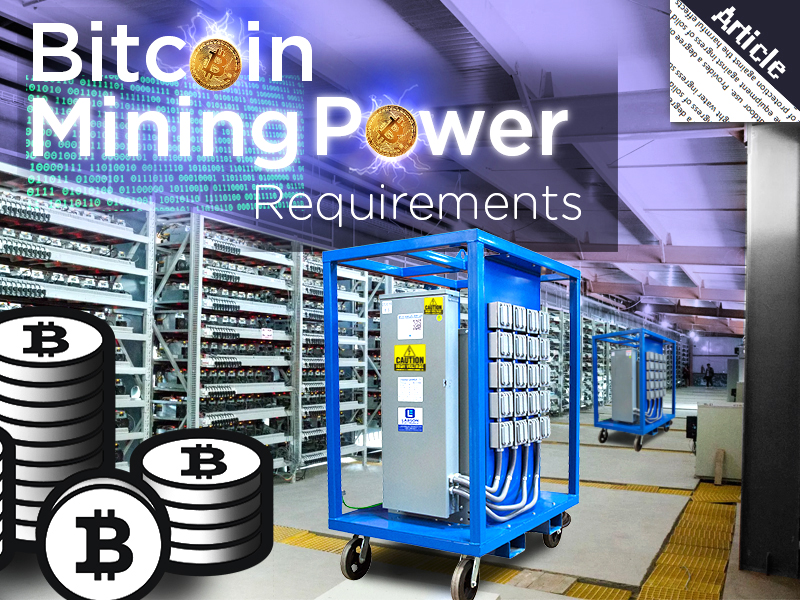
Power distribution systems, both permanent and mobile, play salient roles in the performance of commercial mining businesses. Since ASIC mining equipment comes from countries with different electrical standards, it is important to preserve one’s costly equipment with power distribution panels, through the proper conversion of voltages. Moreover, the units can improve energy efficiency and decrease wastage. Mobile power distribution on carts are also useful, as more and more mining operations are being offered in containers.
As noise may also contribute to decreased performance in electronics, isolation transformers can be utilized to reduce such disturbances. Lastly, large cooling units, in the form of exhaust fans, portable fans, vents and tubes are deployed in digital mining facilities to promote and manage air circulation.