


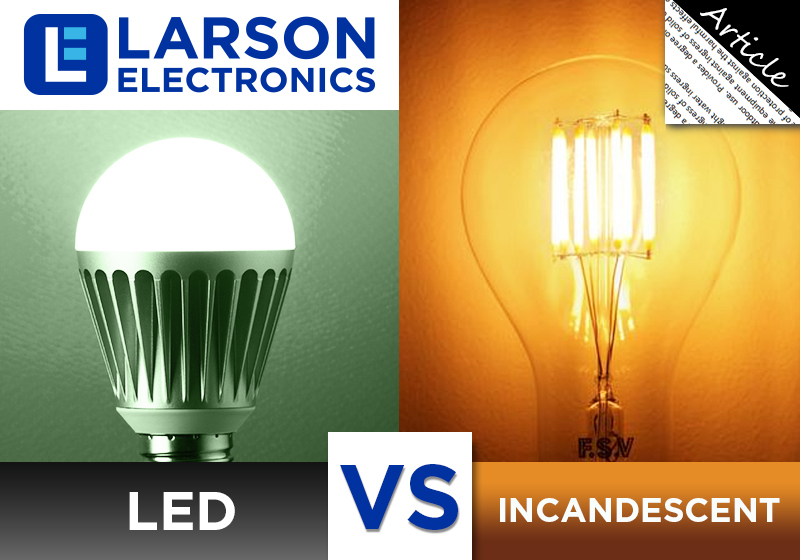
Benefits of LEDs
LEDs have been on the market for a while, and it’s safe to say that most people already know what they are and how they can benefit a consumer. But just in case, here’s a quick rundown:
LEDs are light emitting diodes, and do not require filaments, gas or other substances to produce illumination. The benefits of using LED fixtures include, but are certainly not limited to: the longest lifespans of any light (upwards of 100,000 hours), and high energy efficiency as a result of instant off/on, 180-degree spread, no infrared or UV emissions and very little heat loss. Although initial costs are higher than traditional lights the long-term operational costs are low due to little maintenance or replacement.
What are Incandescent Lights?
Incandescent lights are the original electric light, largely considered the invention of Thomas Edison. The incandescent bulb produces light by heating a filament.
Benefits of Incandescent Lights
When you have the option to choose an LED bulb, is there any incentive to using incandescent? The answer is, yes, though not significantly.
Like LEDs, incandescent does come in a wide range of color temperatures, most popularly the warm glow most associated with cozy home lighting. Incandescent bulbs also usually have exceptional CRI ratings – an incandescent with a color temperature around 2700K has a perfect 100, and the rest generally stay above 95.
Another benefit, is that (similar to LEDs) incandescent bulbs do not normally flicker or cycle on and off as the bulb reaches the end of its life, and have a fairly instantaneous turn on/off.
Disadvantages of Incandescent Lights
Incandescent bulbs are omnidirectional meaning they product 360 degrees of light. This requires the light to be reflected and redirected where needed which causes light spillage and lessens the light’s efficiency overall.
The heat emission, and therefore efficiency, of incandescent lights is notoriously bad. As much as 90% of the light’s energy is lost as heat instead of being used for the intended illumination. They also emit a fair amount of infrared lost as heat. They are also fragile bulbs with breakable filaments, unusable in hazardous or explosive environments.
Furthermore, although incandescent bulbs are cheap to purchase, they have a very short lifespan (roughly 1,200 hours), requiring many replacements throughout the year. This results in high operational and maintenance costs.
While incandescent lights are alright for a home environment, consumers will likely choose LEDs for businesses and larger scale operations where yearly energy costs are more important to financial longevity.