


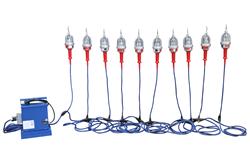
Because of the risks associated with flammable gases, dusts, and particles in hazardous work areas, low voltage lighting systems are a natural choice to increase safety in areas where the potential for combustion exists. This becomes especially challenging when lights must be run at long distances with limited power sources. Low voltage systems typically run on 12-24 volts DC, but even within this lower range, a precise balance between distance, wattage load, and correct wire gauge must be struck if the lighting system is to be effective, efficient, and safe for operators in hazardous locations.
What is voltage drop and how does it occur?
The most significant obstacle to overcome when running a series of string lights over a long distance, such as the use of hand lamps at petrochemical sites or string lights through tunnels and mines, is voltage drop. Voltage drop occurs as the electricity flows from the power source, down the wire, and powers each light along the cord. As the electricity moves through the wire, or conductor, the individual electrons encounter resistance, or friction, from the conductor as well as from one another. This friction causes the electrons to expend their energy in the form of heat rather than as power for the lights. And the higher the resistance along the conductor, the more heat the electrons throw off as they move along the conductor rather than that energy being focused and moved down the wire to power the lamps. Thus, two problems form: 1) unsafe levels of heat begin to build up in the conductor, and 2) at each light connection, less energy is left to power the lamps down the line until noticeable dimming and even complete failure occur at the far end of the string.
As with the pipes in a water system, smaller conductors create more resistance by restricting the flow, whereas larger conductors lessen the resistance and friction by offering more surface area for the electrons to travel along. Because the length of the cord and the light output of the lamp(s) are largely determined by the needs of the job site, the wire gauge is the most negotiable of the system elements. Within reasonable limits, cords can be lengthened and more lights or lumen output added so long as the correct gauge of wire is chosen. Distance, voltage, and wattage can be more precisely balanced – and risk mitigated – simply by using a wire gauge thick enough to allow the current to flow with less impedance. With a thicker conductor, a steady current of power with minimal resistance, thus minimal heat production, can be achieved.
Calculating Voltage Drop and the importance of Wire Gauge
Wire gauges are assigned numbers based using the American Wire Gauge standardized system. In this diameter based system, the smallest wire is numbered 40 and the largest 000; the larger the wire the smaller the assigned number and vice versa. Since the larger wires are based on having a larger diameter, it follows that they will also have more surface area. And more surface area equals less resistance. However, there is a break-even point at which the size of the wire is too expensive and too unwieldy to transport and maneuver, which is especially problematic when using explosion proof handlamps. Designing an efficient, safe, and affordable hazardous location lighting solution depends heavily on using a wire gauge that is large enough to lessen resistance and friction while being small and flexible enough to be transported to and positioned in the work area easily. The goal is a wire gauge that limits the voltage drop to 3% or less for individual lamps connected to the conductor. 5% is considered the maximum drop total for an entire system. Anything above a 3% individual and 5% total drop reduces the efficiency, reliability, and lifespan of the lighting system.
Voltage drop is calculated using the equation E=RI. E represents the voltage drop across the conductor, R the wire resistance in ohms per 1,000 feet, and I the current being drawn in amperes. For example, a 50 watt, 50’ strand of explosion proof LED string lights using 14 gauge copper wire with 3 conductors running on 12V DC pulling 4.17 amps has a voltage drop of 2.92%, which equates to a power level of 11.65 volts at the end of the 50’ cord run. If this system were to use smaller 16 gauge wire, the voltage drop increases to 5.67%, or 11.44 volts at the end of the cord run. While 11.44 doesn’t seem much lower 11.65, the percentage of energy lost has almost doubled with the smaller wire. At this point, the system has passed far beyond the total 5% recommended maximum drop. Almost double the amount of energy is being converted to heat in the wiring rather than as power for the lights. Thus, the lights in the middle through the far end of the cord are noticeably dimmer than those at the front of the line, and reduced equipment life as well as potential malfunction are to be expected. This loss of efficiency as a result of heat build up translates increased repair and replacement costs for owners and employers and, more importantly, into increased risk for operators in hazardous worksites.
When purchasing portable hazardous location lighting, handlamps, string lights, or any other type of lighting system intended to stretch across a long distance, always check the wire gauge and complete a voltage drop calculation first. No one wants to be left in the dark at the end of a long tunnel or encounter wire burn out in the middle of a job that requires complete concentration to complete safely and accurately. While thinner wire gauges seem to save money on the surface, they present a host of problems that eventually cost more money and time to solve in the long run.
Larson Electronics manufactures a wide array of explosion proof, hazardous location, and work area high voltage and low voltage lighting designed to span across long distances. Below is a short list of products specially designed to accommodate for voltage drop:
Part # EPL-SL-10-TXF
Part # EPL-16BS-1X150LED-X24I-C1D1-200
Part # EHL-LED-120XLV-100
Part # WAL-SL-510-LED-12.4-TWP-277V
Part # LM-30-HZ-4X400LTL-LED-EW-WB
Part # LM-SMDE-30-8-5S-4X400LTL-LED-RD-E2E