


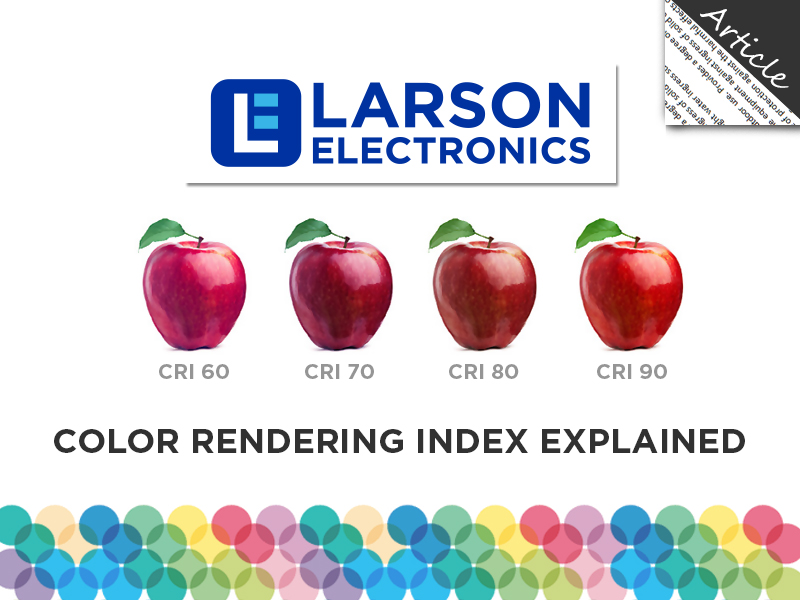
The term CRI is a confusing subject to many everyday consumers, particularly when considering what type of light they need to best suit their application.
So let’s break it down.
What does CRI mean, and what role does it play in lighting?
CRI is short for the Color Rendering Index, and is a measurement of how colors look under a light source, compared to how they look in natural daylight. Or more simply put, the measurement of light in relation to how it affects the appearance of color. When illuminating a space you want the lighting to reflect colors as realistically and “naturally” as possible, especially when working in a spray paint room and for other detailed work.
The Color Rendering Index is a scale of 0 to 100 percent, 100 being the highest level of color accuracy a light source can render. A lower CRI indicates that some colors will appear unnatural when illuminated by the specific light source. (It is important to note that CRI and color temperature are independent of one another; two light sources can have the same colore temperature with different CRIs.
How is CRI Calculated?
CRI is calculated by taking the differences in the chromaticities of eight CIE standard color samples, when they are illuminated by a light source, and by a reference illuminanat of the same correlated color temperature (CCT). The smaller the average difference in chromaticities, the higher the CRI.
Applying CRI to your Lighting Fixtures
When it comes to choosing the correct light bulb for your business, you seriously must consider the CRI of the fixtures. Spray paint rooms, and other detailed working areas will require the highest CRI possible to produce natural, true color, while a breakroom or lobby may not require as high of a CRI.